
The Indian financial services space seems to be in a sweet spot as foreign investors have made a net investment of Rs 14,205 crore ($2.1 billion) in the sector in November amid strong credit growth and manageable non-performing loan portfolio. The investment comes following a net withdrawal of Rs 4,686 crore from financial services stocks in October on account of profit booking. Overall, foreign portfolio investors (FPIs) have made a net investment of Rs 36,238 crore in the country's equity markets in November.

Looking to regain lost ground in the credit cards segment, HDFC Bank on Monday announced a tie-up with leading payments company Paytm to start selling co-branded plastics before the onset of the festive season. The credit cards will be powered by Visa and will include offerings targeted at millennials, business owners and merchants, an official statement said. Paytm has a reach of over 330 million consumers and 21 million merchants, while HDFC Bank has over 5 million debit, credit and prepaid cards, and serves 2 million merchants through its offerings.

Preparing for the Paris Olympics along with her teammates, Batra said she has learned from her Tokyo Games experience.

Private sector lender Yes Bank on Saturday reported a 46.7 per cent growth in net profit to Rs 502 crore for the June 2024 quarter, helped by a reduction in provisions. The city-headquartered bank's core net interest income rose 12.2 per cent to Rs 2,000 crore. Its net interest margin stayed flat at 2.4 per cent.

'As we enter 2025, it must be acknowledged that there is a convergence of capital, influential people (from business and politics) and technology deciding the destiny of others in the name of pride, patriotism, nationalism, nation building, all of it thinly veiled disguises for personal profit and glory,' asserts Shyam G Menon.

The meeting in New Delhi etc is just the BJP being nice to the man who helped it realise its dream by stabbing Uddhav in the back, notes Saisuresh Sivaswamy.

Banks looking to raise capital via bond sales to fund decade-high credit growth were compelled to put some of these debt issuances on hold amid a sharp rise in yields since late September, sources told Business Standard. A major private lender, Axis Bank, has not yet followed through with a planned issuance of infrastructure bonds worth around Rs 3,000 crore. This is because volatility in the bond market in late September led to investors seeking higher yields, sources said.
Shares of ICICI Bank may outperform those of HDFC Bank in the near-term, analysts said recently, after the Sandeep Bakhshi-led private sector lender reported a strong set of numbers for the July to September quarter (Q2) of financial year 2023-24 (FY24). The result, they said, reiterated that ICICI Bank is maintaining a sustainable and prudent growth led by tech-driven initiatives as against HDFC Bank, which is facing merger related challenges. According to analysts at Prabhudas Lilladher, ICICI Bank is valued at par with HDFC Bank at 2.2x/1.9x on FY25/26E core adjusted book value (ABV) basis.

Banks submitted bids amounting to Rs 4.75 trillion, around 2.5 times of the notified amount of Rs 1.75 trillion, at the Variable Rate Reverse Repo (VRR) auction conducted by the Reserve Bank of India (RBI) on December 22, a day after the liquidity deficit in the banking system widened to Rs 2.5 trillion. In the most recent VRR auction held by the RBI on December 15, bids totaling 2.7 times the notified amount were received. Banks secured Rs 1 trillion at a weighted average rate of 6.63 per cent.

Self-employed individuals often face hurdles in buying term insurance due to financial documentation that doesn't fully reflect their earnings. This complicates underwriting.

Given the uncertain macroeconomic conditions, most brokerages have turned slightly cautious on the pace of growth in State Bank of India's (SBI's) earnings going ahead. While they don't see any significant risk arising for now, its sheer balance sheet size and systematic importance has nudged them to cut earnings estimates for fiscal year 2023-24 (FY24) and 2024-25 (FY25) up to 5 per cent. India's largest state-owned bank, on Thursday, reported standalone net profit of Rs 16,694.51 crore for Q4FY23.

Recent RBI data indicates net addition of credit cards is running strong at 18 per cent year-on-year (Y-o-Y), but growth in credit card limits is ahead of loans outstanding. Growth in lower limit cards is decelerating fastest. The West and South have more usage and online transactions are more popular than offline, with metros leading growth.

'We are sure FY25 is going to be better...But to call out that all problems are behind us is a bit early.' 'The underlying business sentiment has not changed significantly.'

'Auto, pharma, and industrials have delivered well in the recent quarter, while businesses like quick-service restaurants, consumer staples, and durables have underperformed in volume growth.'

'Subject to any worldwide economic collapse.'

'Our preference remains for the less-expensive industrial stocks, which are showing good earnings momentum.'
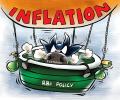
"We have to stand in readiness to go beyond keeping Arjuna's eye to deploying policy instruments, if necessary" to contain inflation, said Reserve Bank Governor Shaktikanta Das on Thursday. Headline consumer price index-based inflation projection for the second quarter of 2023-24 has been revised up substantially, primarily due to the price shock from vegetables, at 6.2 per cent by the RBI form 5.2 per cent estimated in June. Unveiling the bi-monthly monetary policy, Governor Das said the moderation in headline inflation to 4.6 per cent in the first quarter of 2023-24 was in line with the projections set out in the June MPC meeting.

India's manufacturing sector witnessed a modest growth in May, but going ahead "weak demand conditions" may persist.

Standard Chartered's India strategy will focus on wealth management while credit card will remain core to its business though will avoid competition with the country's private banks, said a senior executive of the British lender. "Our focus on wealth management and affluent clients are central to our existence. "We are strong in these areas and we want to grow in these areas.

'It is difficult to write business internationally, without an 'A-' rating. It becomes more expensive.'

An in-line ICICI Bank result for the quarter ended March 31, 2024, has led to analysts raising target price and earnings per share (EPS) forecast on the stock. ICICI Bank, they said, appeared least vulnerable to regulatory action on its digital offerings or for risk monitoring lapses.

Really pained by events in Indian wrestling but hopeful of two medals: Yogeshwar Dutt

Surplus liquidity in the banking system as measured by absorption of excess funds by the Reserve Bank of India (RBI) fell sharply at the end of the last week due to outflows on account of advance tax payments. According to the RBI data, the net liquidity absorbed by the central bank on September 16 was at Rs 3,243.57 crore, much lower than the average of Rs 56,809.92 crore in the preceding four days of the week. The average absorption of funds by the RBI so far in September is at Rs 1.13 trillion, against the average of Rs 1.2 trillion in the previous month, the data showed.

Days after JP Morgan announced the inclusion of government bonds in its emerging market (EM) bond index, a host of banks and other financial institutions (FIs) are set to tap the debt market. They plan to raise Rs 18,000 crore by issuing non-convertible debentures (NCDs) and bonds. National Bank for Agriculture and Rural Development (Nabard) plans to raise up to Rs 3,000 crore via five-year social impact bonds on Tuesday, the first of its kind in India.

Debit card payments remained sluggish due to the surge in digital transactions after the pandemic, and the Unified Payments Interface (UPI) has emerged as the most popular mode of money transfer, particularly for small value transactions, according to RBI data. In July 2020, the total debit card spends stood at Rs 2.81 trillion, as compared to Rs 3.15 trillion in July 2023, reflecting a growth of 11.96 per cent. UPI spends have seen a whopping growth of 428 per cent, zooming from Rs 2.90 trillion to Rs 15.33 trillion during the same period, the data revealed.

'Our unsecured loan is not exactly unsecured. It is backed by cash flow of customers.'

Covid-19 pandemic that brought life to a near standstill in 2020 has left Indian adults poorer by 6.1 per cent in 2020, suggests the Credit Suisse Global Wealth Report 2021. Wealth per Indian adult in 2020, according to the report, dropped to $14,252 by 2020-end compared to pre-pandemic levels. On a cumulative basis, Credit Suisse estimates the drop in the wealth of Indian adults at $594 billion.

Average monthly GST collection rose from Rs 90,000 crore during the first year of its implementation -- 2017-2018 -- to Rs 1.68 trillion during 2023-2024, representing an 87 per cent rise.

Domestic air passenger traffic grew 5.1 per cent year-on-year to an estimated 138.9 million in May and was significantly higher by around 14 per cent than pre-Covid levels, credit ratings agency Icra said on Thursday. Icra also said the outlook on the Indian aviation industry is stable amid the continued recovery in domestic and international air passenger traffic with a relatively stable cost environment and expectations of the trend continuing in FY2025.

The two-wheeler segment has shown signs of recovery in the first half (H1) of calendar year (CY) 2024, largely driven by improving performance in rural areas. According to the Federation of Automobile Dealers Associations, rural contribution to two-wheeler sales surged by 57-60 per cent in the April-June quarter of 2024-25, indicating a rising demand in these regions. Experts believe that this trend will continue, supported by a favourable monsoon season and government initiatives aimed at rural development.

India's economic growth prospects should remain strong over the medium term, with GDP expanding 6-7.1 per cent annually in fiscal years 2024-2026, S&P Global Ratings said on Thursday. In a report titled 'Global Banks Country-By-Country Outlook 2024', S&P said the banking sector's weak loans will decline to 3-3.5 per cent of gross advances by March 31, 2025, on the back of structural improvement, including healthy corporate balance sheets, tighter underwriting standards and improved risk-management practices. Interest rates in India are unlikely to rise materially, and this should limit the risk for the banking industry, it added.

To minimise risk, invest in a debt fund whose duration matches your investment timeframe.

'The focus needs to shift towards the ability to collect payments, particularly in tier-3 to tier-4 areas where acceptance is still lacking.'

For now, the concerns over bad loans have taken a back seat; a bigger challenge for the banking community is credit growth, explains Tamal Bandyopadhyay.

Supported by slightly stronger global growth, improving export competitiveness and implementation of recently approved investment projects, India's growth is expected to recover from 4.4 per cent in 2013 to 5.4 per cent in 2014, the IMF said.

Overall, the credit profiles of players will be supported by healthy balance sheets and liquidity. Prudence in capital and development expenditure, efficient working-capital management, and recent equity raising will help sustain credit metrics in FY22.

'The last year's growth is a foretaste of things to come in the retail credit market.'

Indian economy is poised to do better on the back of reforms undertaken by the government and is expected to clock a 6.5-7 per cent growth in the remaining part of the decade, Chief Economic Advisor (CEA) V Anantha Nageswaran said on Tuesday. Addressing reporters here after the tabling of the Economic Survey in Parliament by Finance Minister Nirmala Sitharaman, Nageswaran said that by and large, inflation is likely to be "well behaved" in FY2023-24 barring headwinds. "My optimism is that in the coming decade, rest of the decade, the potential GDP growth, without taking into account export potential, because global economy is still rife with uncertainty, the growth rate would be around 6.5 to 7 per cent, rather than between 6 per cent and 6.5 per cent," he said.

The 30-year-old, who won Olympic gold at the Rio Olympics in 2016, will miss this year's Olympic Games in Paris.

While Lamichhane admitted that playing amid the pandemic has been "challenging and difficult", the joy of taking the ball in hand was enough for the leg-spinner to beat COVID-19 blues having contracted the virus last year in November.
